
The Voice Recorder Is the New Calculator

Calculators helped us solve the problems we were given. In the age of AI agents, the advantage lies in noticing which problems deserve to be solved.
Every week, another product promises to capture your thoughts before they disappear.
Meeting recorders that turn conversations into summaries. Voice notes that become tasks. Apps that pull ideas from a walk, a Slack thread, a half-finished email, or the two seconds before you fall asleep. There is a growing industry built around a simple fear: What if I have a good idea and lose it?
Notice where the demand is gathering. People are looking for tools that catch thoughts, meetings, and fragments of intent, not another calculator that gives them an answer they could have worked out themselves. We are starting to understand that the harder problem is often not calculation. It is deciding what is worth doing with the answer.
That fear made sense when turning an idea into something real was expensive.
A useful thought needed a writer, designer, developer, researcher, editor, marketer, and enough time to coordinate them. Most ideas died before they had a chance, not because they were bad, but because the distance between “what if?” and a working version was too large.
That distance is shrinking fast.
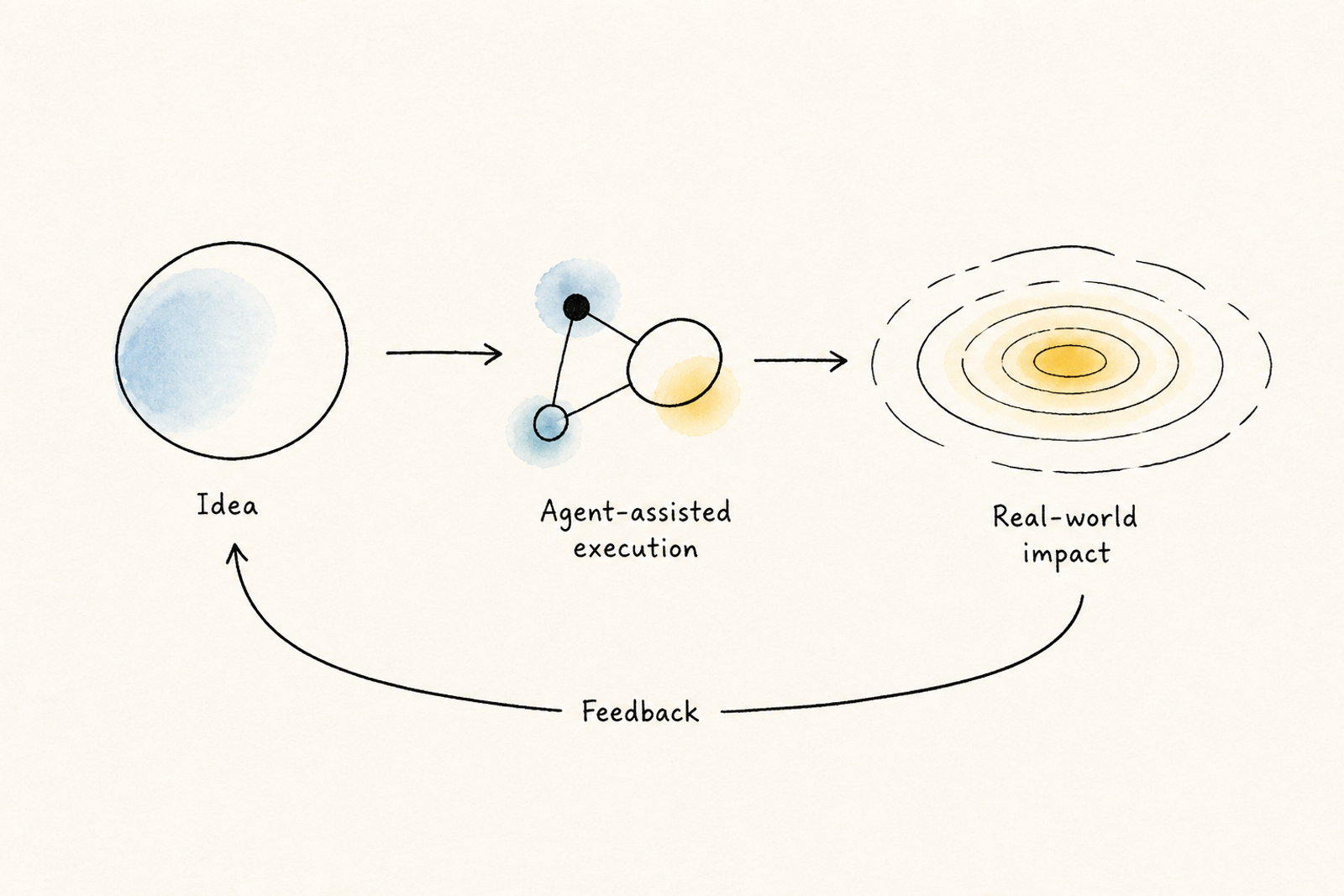
You can describe an app to an agent and get a prototype. You can turn a messy set of notes into a proposal, a website, a lesson plan, a video script, or a working piece of software. You can ask an AI to research, structure, draft, code, revise, translate, test, and keep going while you sleep.
The barrier to making is falling.
Which means the competition is moving somewhere else.
It is moving to the question of what to make.

The scarce thing is becoming judgment
When execution becomes cheaper, mediocre ideas become easier to ship too.
We will have more products, more content, more brands, more apps, more “solutions,” and more things nobody truly needed. The internet already has a surplus of output. AI will multiply it.
That does not mean ideas suddenly matter because every idea needs to be revolutionary. Most do not. It means the ability to notice a real problem, frame it properly, and imagine a better response is becoming more valuable.
The valuable person may not be the one who can produce the most slides, code, images, or emails. It may be the person who can see what is worth producing in the first place.
That takes more than creativity in the loose sense of “having lots of ideas.” It takes taste. Empathy. Curiosity. Context. The ability to spot an irritation everyone else has accepted as normal. The ability to ask a question that changes the direction of a room.
It also takes moral judgment.
Because an idea can be technically impressive and still make life worse. An agent can automate customer support, but does it leave people stranded when they need a human? It can optimize a school system, but does it reduce a child to a performance score? It can make marketing more persuasive, but is it helping someone decide or simply becoming harder to ignore?
The new skill is not simply prompting machines better. It is deciding what deserves to exist, who it serves, and what trade-off it creates.
We have trained people for a world of assigned work
Much of education still reflects an older economic model.
Students are given a question. They are taught the accepted method. They complete the task. They are graded on accuracy, speed, neatness, and compliance with the instructions.
Those skills matter. Logic matters. Numeracy matters. Discipline matters. The ability to finish something matters.
But a system built mostly around right answers can quietly train children to wait for the question. A device can capture every spark of an idea, but if our brains have only been trained to solve the approved answer to someone else’s question, the device will still be empty. It can preserve a thought. It cannot supply the curiosity, courage, or point of view that gives the thought weight.
It can reward the student who follows the brief perfectly while giving less space to the student who asks whether the brief is wrong. It can make failure feel like a verdict instead of evidence. It can teach children to avoid strange ideas because strange ideas are harder to grade.
That may have been a practical way to prepare people for organizations built on hierarchy and predictable roles. Follow the process. Do the assigned task. Be reliable.
But we are entering a period where a teenager with a laptop, an internet connection, and a few capable agents can try ideas that used to require a small company.
They can build a tool for their school. Make a game that teaches something. Create a community resource. Test a business. Design a campaign for a local problem. Make something weird. Make something useful. Sometimes make something that fails completely.
That last part matters.
A child who only learns to avoid mistakes will struggle in a world where progress often comes from making a rough version, showing it to people, learning what failed, and trying again.
Let kids be unreasonable sometimes
Children are naturally good at asking inconvenient questions.
Why is this done this way? Why can’t it work differently? Why do adults accept this? What happens if we try something ridiculous?
We tend to train that instinct out of them. We call it distraction, lack of focus, immaturity, or being unrealistic. Sometimes it is. But sometimes “unrealistic” is just the first stage of an idea before someone has bothered to build it.
The falling cost of creation gives children more room to be productively unreasonable.
They do not need permission from a large institution to make a first version anymore. They need guidance: how to frame a problem, how to find out whether people actually have it, how to build responsibly, how to recognize harm, and how to keep going when the first attempt is embarrassing.
We should teach them to make things before they are fully certain.
We should also teach them not to confuse speed with value. Agents can produce output quickly. That does not make the output meaningful. A polished prototype can hide a shallow idea. A confident answer can still be wrong. A popular product can still be harmful.
The work is to build discernment alongside capability.
The question we should teach: “What changes for someone?”
Before making something, children and adults alike should learn to ask:
- Who is this for?
- What part of their life gets easier, safer, more joyful, more dignified, or more possible?
- What could go wrong?
- Who might be excluded or harmed?
- How will we know if it actually helped?
- Is this worth making, or is it simply easy to make?
These are not soft questions. They are the questions that separate activity from impact.
We cannot perfectly predict how an idea will affect people’s lives. We should be suspicious of anyone who claims they can. But we can get closer by involving people early, watching what they do rather than only listening to what they say, and staying willing to change course.
That is a better model of intelligence than simply delivering the assigned answer.
A different kind of literacy
AI literacy should not stop at knowing how to use Grok, Hermes, Codex, or whatever comes next.
It should include knowing when to use them, when to question them, and what responsibility comes with giving them a command.
For decades, the calculator represented a certain kind of progress. Give it a defined problem and it helps produce the answer. It made calculation faster and more accessible, but it still depended on someone knowing what to ask.
The voice recorder begins one step earlier. It captures the unfinished thought, the strange observation, the frustration someone has learned to tolerate, or the question that has not yet become a task. It preserves the raw material from which a worthwhile problem can be framed.
As AI agents take on more of the solving, that earlier moment becomes more valuable. The advantage shifts from producing answers to noticing what deserves an answer—from completing assigned work to recognizing work worth doing.
This does not mean less logic or less rigor. It means applying both to better questions. We should reward imagination with accountability, experimentation with reflection, and the courage to pursue an observation before its value is obvious.
In that sense, the voice recorder is the new calculator.
One helped us answer the questions we were given. The other helps us catch the questions before they disappear.
The future may belong less to the people who can follow instructions fastest and more to the people who pay attention: to friction, possibility, and what could change for someone.
That is what we should help our kids practice now.