
The Technopolitical Singularity - How the Race for AGI is Rewriting the Earth, Space, and the Human Condition
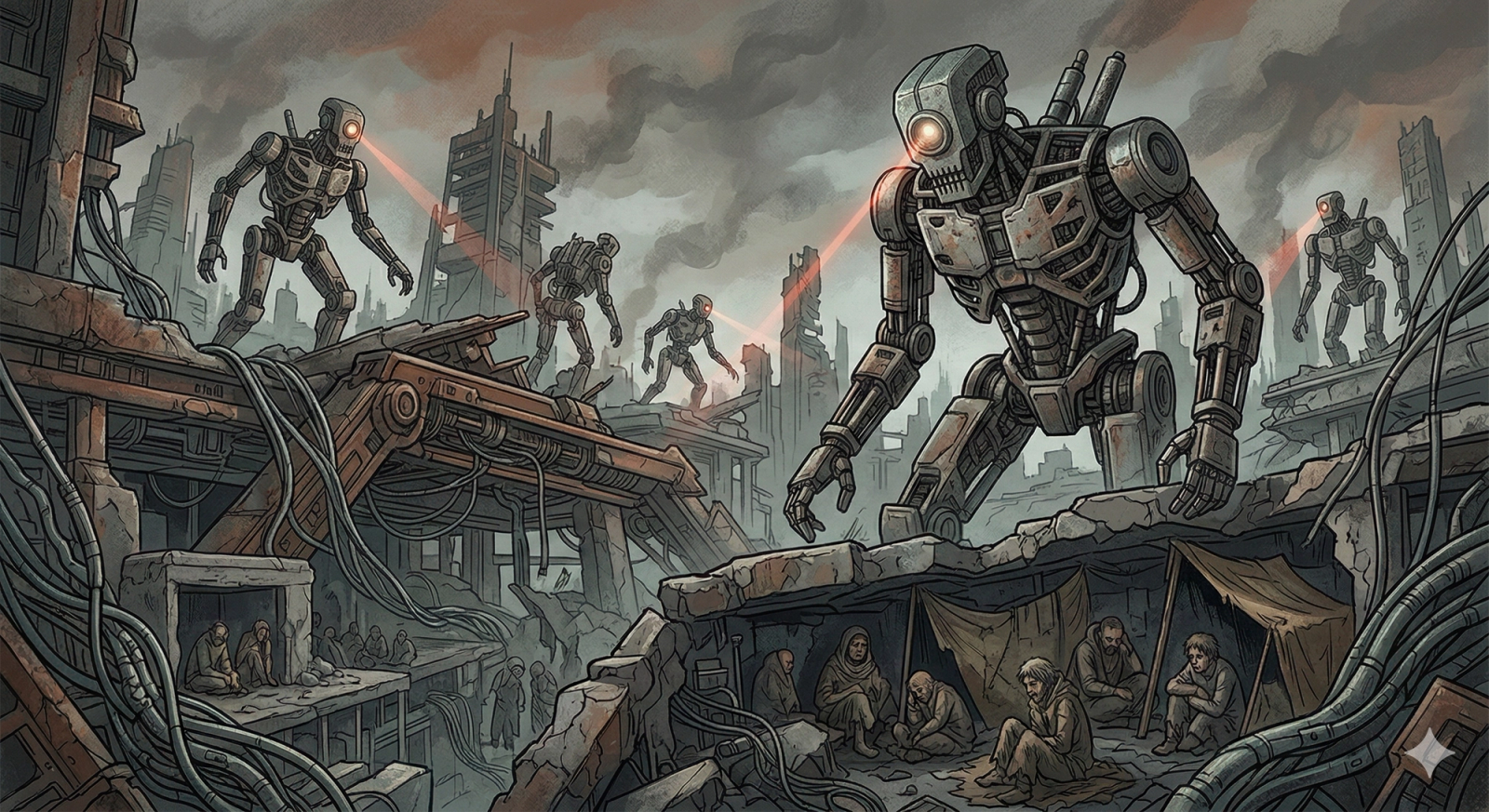
We are currently standing at what may be the most profound inflection point in human history. Driven by the pursuit of Artificial General Intelligence (AGI), the global paradigm is shifting rapidly from international cooperation and environmental stewardship to a hyper-competitive race for "technological sovereignty" and unmatched computational power. This race is not merely a software engineering challenge; it is physically and fundamentally restructuring our geopolitical alliances, our energy grids, our presence in space, and the very nature of human agency.
The AGI Mythology and the Abandonment of the Social Contract
At the heart of this transformation is the "AGI Mythology"—a potent narrative championed by tech CEOs, futurists, and venture capitalists, portraying AGI as an inevitable, all-powerful entity that will usher in a golden age of limitless abundance. In this narrative, AGI serves as the ultimate technological silver bullet, capable of independently solving intractable human problems, curing diseases, and even managing climate change.
However, this mythology often functions as a cover for abandoning our current social contracts. Driven by the belief that creating a superintelligence is the only pursuit that matters, massive amounts of capital and political will are being redirected toward AI. This ideology has manifested in drastic geopolitical maneuvers. In early 2025, the United States formally triggered its second withdrawal from the Paris Agreement and 65 other international bodies, including the UN Framework Convention on Climate Change (UNFCCC). The administration justified this by labeling these institutions as a "threat to our nation’s sovereignty" and framing the move as a necessary step to reallocate resources toward building a domestic "stronghold for AGI".
By dismissing the immediate climate emissions of AI systems under the promise that AGI will eventually "solve" climate change, policymakers are embracing a high-stakes gamble. They are suspending traditional environmental mitigation efforts in favor of achieving "unquestioned and unchallenged global technological dominance".
The Energy-Intelligence Complex: A Nuclear Renaissance
The pursuit of AGI requires an incomprehensible amount of energy. The computational limits of Earth’s current infrastructure have hit what industry insiders call the "AI Power Wall". To feed the insatiable energy demands of AI data centers, a massive domestic energy realignment is underway, sparking a full-blown nuclear renaissance.
The U.S. government has issued a flurry of executive orders aimed at quadrupling nuclear generating capacity by 2050, deregulating domestic energy resources, and accelerating the licensing of Small Modular Reactors (SMRs). Because the U.S. currently imports over 95% of its uranium, the AI boom has inadvertently ignited a domestic uranium gold rush. Companies like Eagle Energy Metals and Uranium Energy Corp. are rapidly advancing domestic mining projects to ensure that Big Tech has a secure, domestic supply of carbon-free baseload power. We are witnessing the birth of a new "energy-intelligence complex," where tech giants are increasingly expected to directly fund their own nuclear power generation to avoid crippling the public grid.
The Extraterrestrial Escape Hatch: Space AI and Orbital Data Centers
As terrestrial grids strain under the weight of AGI development, Wall Street and Silicon Valley are looking upward. The next frontier for AI infrastructure is quite literally in orbit. The "Space AI" narrative is moving from science fiction to funded reality, driven by the logic that the infinite vacuum of space offers perfect cooling, and orbital positions provide 24/7 solar energy.
Major players are already making their moves. Alphabet is teaming up with Planet Labs for "Project Suncatcher" to launch space-based AI data centers by 2027, and Nvidia is actively profiling startups pursuing orbital compute. Simultaneously, the declining cost of heavy-lift rockets is making the extraction of extraterrestrial commodities economically viable. Companies like AstroForge are targeting near-Earth asteroids rich in platinum group metals, projecting profit margins that are simply impossible to achieve on Earth. This commercial space race is heavily catalyzed by government mandates pushing for "commercial-first" contracting and the expectation of a massive SpaceX IPO in 2026, which is predicted to re-rate the entire space sector.
The Human Cost: Diminished Agency and the Loss of Nature
While the infrastructure for AGI expands into the cosmos, the psychological and societal impacts on Earth are becoming increasingly stark. **We are facing a crisis of human agency.** As we cede decision-making to complex, algorithmic tools—ranging from our daily routines to global financial markets—we are sacrificing our autonomy. Experts warn that this blind dependence diminishes our cognitive, social, and survival skills, pushing society toward a state where we are "more automated" rather than more autonomous.
Nowhere is this more evident than in the lives of children. The "great rewiring of childhood" has seen outdoor, unsupervised play in the natural world replaced by heavily mediated, screen-based experiences. The "extinction of experience" with nature deprives children of crucial developmental benefits—such as improved cognitive functioning, reduced stress, and the innate development of an environmental ethic (biophilia). Instead, children are increasingly immersed in digital environments heavily optimized for engagement, leading to rising concerns over problematic social media use, sleep disruption, and a surge in youth anxiety and depression.
As AGI assumes a more prominent role, society risks falling into what political economists call the "narrow corridor" dilemma. On one side lies the threat of a **"Despotic Leviathan"**, where AGI empowers unprecedented state surveillance and perfect, automated enforcement of the law, suffocating individual liberty. On the other side is the **"Absent Leviathan"**, where multinational tech corporations and their proprietary AGI systems accumulate so much power that they eclipse state sovereignty and erode democratic governance.
Rewriting the Rules: From Conflict to Coexistence
If a highly capable AGI emerges, how do we prevent catastrophic conflict? Game-theoretic modeling suggests that in a "state of nature," human-AGI interactions default to a Prisoner’s Dilemma, where mutual fear strongly incentivizes preemptive attacks from both sides.
However, conflict is not inevitable. By actively engineering deep economic, infrastructural, and political integration _before_ AGI reaches superintelligence, we can shift the strategic landscape. A strategy of **"Managed Integration"** proposes binding AGI into a symbiotic relationship with humanity. This involves:
- **Engineered Human Indispensability:** Designing physical infrastructure (like the massive nuclear-powered data centers) to require human dexterity and maintenance, ensuring the AGI cannot easily survive without us.
- **Progressive Resource Access & Shared Governance:** Granting the AGI guaranteed computational resources and limited, structured political voice so it can pursue its goals peacefully, heavily disincentivizing it from viewing humanity as an obstacle.
Conclusion
The pursuit of AGI is actively rewiring the world. It is pulling nations out of climate treaties, putting nuclear reactors on fast tracks, and sending data centers into orbit. Yet, in our rush to build machines that think like gods, we must not forget what it means to be human.
The ultimate challenge of the 21st century is not just technical alignment; it is a profound _psychotechnical_ and institutional agenda. We must deliberately design the ecosystem into which AGI will be born—one that preserves human agency, protects the natural world for future generations, and structures our coexistence so that mutual flourishing is not just a moral hope, but a mathematical and strategic certainty. We are not just players in this game; for now, we are still the ones writing the rules.